
The Distribution Lock
Why Higgsfield ai is the most likely first mover in AI-native long-form television.

Analysis · AI-Native Production
May 2026 · Structural analysis of incentive architecture, production economics, and the vertical integration problem the AI video space has not yet named out loud.

There is a version of the Higgsfield story that is easy to tell and largely correct: a San Francisco-based AI video platform scaled to 20 million users and $300 million ARR inside of eighteen months, demonstrated 100-to-1 cost compression against conventional feature film production at Cannes, and now sits at a $1.3 billion valuation with $130 million in institutional backing from Accel, Menlo Ventures, and GFT Ventures.
That version of the story is not wrong. It is simply incomplete. The more interesting version — and the one with actual analytical consequence for the entertainment industry — concerns not what Higgsfield has built, but what the existence of what they’ve built reveals about the entity most likely to produce the first AI-native prestige long-form series, and the structural problem that stands between Higgsfield’s demonstrated production capability and the moment that production reaches a domestic audience.
The Cannes benchmark and what it actually proves
Hell Grind screened at Cinema Olympia in Cannes on May 21, 2026. It was not an official Cannes selection — the festival has not extended its imprimatur to AI-generated work, a position that is selective rather than principled given its parallel embrace of AI-assisted productions — but what occurred at the Marché du Film event carries real evidentiary weight regardless of the credentialing argument. A 95-minute science fiction feature was produced by a 15-person team in 14 days for under $500,000, of which approximately $400,000 went directly to compute costs.
The compression ratio is the headline figure, and it has dominated coverage. It should not be. The more analytically significant number is the 80% internal compute-to-total-budget ratio, because that ratio describes something structural about where value is created in an AI-native production and where the legacy cost architecture of conventional production is concentrated. When 80 cents of every dollar is compute and 20 cents is everything else, you have not made a cheaper version of a conventional film. You have made a categorically different object with a categorically different cost architecture that happens to output the same deliverable format.
That is not a marginal improvement on how films get made. That is the elimination of an entire industrial apparatus — physical production, guild labor, location logistics, talent dependency, post-production infrastructure — and the legal architecture that gatekeeps access to all of it. What remains is cloud compute and a directing workflow.
That last element deserves its own beat, because it is routinely underweighted in discussions of AI-native production economics. Entertainment legal counsel is not merely a cost in conventional production. It is a structural gatekeeper at every transaction point where a production requires incumbent cooperation to proceed. The E&O carrier won’t underwrite without counsel sign-off. The guild opinion letter is a legal instrument. The distribution agreement doesn’t move until both sides’ counsel are aligned. The clearance process for every production element runs through legal review. In the conventional model, counsel is not facilitating these transactions so much as conditioning them — holding veto authority at each stage with full professional liability protection for exercising it. And because entertainment law as a discipline has decades of institutional alignment with the guild and talent infrastructure the AI-native model most directly threatens, the counsel pool itself carries the same structural bias toward deferral that the studios do, with fiduciary cover attached. The AI-native production model does not merely reduce legal costs. It removes the gatekeeping function entirely — which is a different order of disruption than cost compression alone suggests.
This is why the compression rate is not merely a production efficiency story. It is a threat assessment.
The “one cycle away” defense and what it actually is
The entertainment industry’s institutional response to AI-native production capability has followed a consistent pattern over the past three years: acknowledge the technology’s potential, announce exploratory initiatives, reference the readiness problem, and defer. The readiness problem — the persistent claim that character consistency at series scale, or narrative coherence across episode count, or some other technical threshold has not yet been cleared — has functioned as the industry’s primary justification for not building.
This framing has a testable implication that the evidence does not support. If the tools were genuinely the binding constraint, you would expect to see active production attempts stalled at specific technical bottlenecks. You do not. What you see, across every major studio and streaming platform that has publicly committed to AI-native exploration, is an absence of production attempts entirely. Not stalled productions. No productions.
An absence is not a technical problem. An absence is a choice. And choices, in institutional contexts, reflect incentive structures.
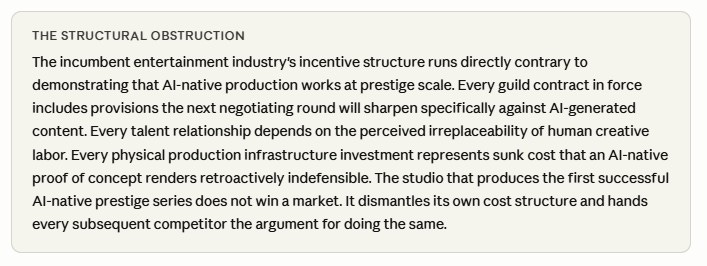
“One production cycle away” is not a technical assessment. It is the institutional equivalent of a perpetual deferral mechanism — one that happens to align perfectly with the organizational interests of the entity offering it. The studios are not waiting for better tools. They are waiting for someone else to be first, so that the precedent is set under someone else’s name and the labor relations fallout lands on someone else’s doorstep.
Why Higgsfield is the most likely first mover
The case for Higgsfield as the entity most likely to produce the first AI-native prestige long-form series is not primarily a capability argument, though the capability argument is now substantively made by Hell Grind. It is a structural argument about who benefits from deferral and who does not.
Higgsfield has no guild relationships to protect. It has no physical production division whose P&L is undermined by demonstrating that physical production infrastructure is unnecessary. It has no talent relationships that become adversarial the moment it proves out an end-to-end pipeline. It has no institutional legal architecture whose continued relevance depends on the conventional production model remaining intact. Its incentive structure is the inverse of every incumbent: every month the first AI-native prestige series does not exist is a month in which Higgsfield’s most commercially significant claim remains theoretical.
Hell Grind closed that gap at the feature level. The 83–87% compression benchmark against conventional production midpoints is now a documented data point rather than a projection. That documentation matters because it transforms the conversation from “can AI-native production achieve this” to “what is preventing it from being deployed at series scale.”
The answer to that question is not technical. It is distributional.
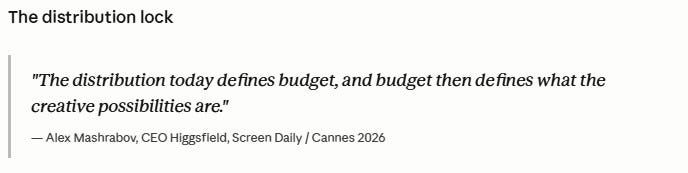
The observation is accurate. It is also, from Higgsfield’s strategic position, something close to a self-description of the problem they have not yet solved.
The gap between producing the first AI-native prestige series and distributing it is not closed by demonstrating production capability. It is closed by negotiating a distribution deal — and distribution deals, in the domestic market, are negotiated with entities whose institutional interests are structurally aligned against the model Higgsfield represents. A streaming platform that acquires an AI-native series has, in that acquisition, provided public validation that the production model works at scale. That validation immediately becomes a reference point in every subsequent guild negotiation, every talent conversation, and every internal production cost justification meeting the acquiring studio will ever have.
The acquiring entity does not simply buy a series. It buys a problem.
The incumbent response to this reality is already legible in the current landscape. Productions that have approached major domestic platforms with AI-native prestige series have encountered a pattern distinct from conventional development friction: not outright rejection, but iterative deferral. Requests for additional technical validation. Requests for proof-of-concept deliverables. Requests for guild opinion letters. Requests for E&O insurance confirmation — a threshold that carries its own structural obstruction, given that traditional carriers maintain absolute AI exclusions and the only viable underwriting path runs through specialty markets that most productions lack the legal architecture to access. Each request individually reasonable, collectively constituting a slow-walk posture that has thus far produced no greenlit AI-native long-form productions and shows no structural tendency toward producing one. The math on this trajectory suggests that a domestically distributed AI-native prestige series from an industry-adjacent production entity emerges at best in late 2026, more likely in early 2027.
That timeline is not a function of tool readiness. It is a function of institutional incentive.
The postulation: vertical integration as strategic necessity
The 83–87% compression benchmark that Hell Grind established is not a static achievement. It is a time-sensitive one. The AI video model landscape is consolidating rapidly around a small number of frontier providers — Google’s Veo, Kuaishou’s Kling, ByteDance’s Seedance, Runway’s Gen-4.5 — and Higgsfield’s orchestration layer advantage is itself a diminishing differential as these providers develop their own orchestration capabilities. The compression rate that exists today is a function of being early. It will narrow.
The window in which a demonstrated AI-native prestige series production can claim a genuine first-mover position in the domestic market is therefore finite, and it is being closed from both ends: by the inevitable maturation of competing platforms, and by the industry’s deliberate slow-walk posture toward distribution deals.
If that slow-walk posture is the binding constraint — and the structural analysis above suggests it is — then the logical resolution is not to wait for the industry to move, but to remove the dependency on the industry moving at all. In practical terms, this means Higgsfield acquiring domestic distribution rights to the first prestige AI-native long-form series produced on its platform, rather than licensing those rights to an incumbent distributor at terms and on a timeline the incumbent controls.
This is not a conventional platform play. Higgsfield’s current positioning is as a production infrastructure company. Acquiring domestic rights would represent a vertical integration move into territory currently occupied by streaming platforms and studio distributors. It would require capital deployment against rights acquisition rather than infrastructure development. It would require distribution infrastructure — licensing, localization, exhibition partnerships — that Higgsfield does not currently maintain. And it would put the company in direct competition with the domestic distribution entities whose cooperation it will eventually need for the broader market.
None of these are fatal objections. They are cost calculations. The question the analysis forces is whether the cost of vertical integration into domestic rights acquisition is higher or lower than the cost of watching the compression advantage that Hell Grind established expire inside an industry slow-walk that has no structural endpoint.
Higgsfield’s own Originals platform — launched in March 2026, currently distributing AI-generated episodic content directly to audiences — suggests the company has at least partially internalized this logic at the short-form level. The strategic question is whether the same logic applies at prestige long-form scale, where the compression rate differential is largest, the production capability is now demonstrated, and the distribution bottleneck is most deliberately maintained.
What this analysis cannot resolve
For this to read as analysis rather than advocacy, three genuinely open questions must be carried.
The first is whether Higgsfield’s current capital position and institutional risk appetite support a rights acquisition play at prestige long-form scale. Hell Grind was produced for under $500,000. A prestige series domestic rights acquisition represents a materially different capital commitment against a content category that has not yet demonstrated audience uptake at that scale. The $130 million Series A is substantial. It was not raised to fund content rights.
The second is whether the first-mover advantage in AI-native prestige production accrues to the platform or to the content. If the prestige series that establishes the proof of concept is produced on Higgsfield’s infrastructure but distributed by an independent production entity — one that maintains full IP ownership and uses Higgsfield as a production pipeline under a trade-secret architecture — then the documented first-mover position may belong to the production entity and distribution partner rather than to Higgsfield as a platform. Higgsfield provides the infrastructure. It does not, under that model, own the precedent.
The third unresolved question is the reputational overhang from early 2026: distribution of content that drew racism and sexism allegations, influencer payment disputes, and an X account suspension for inauthentic behavior generated significant negative press and the “Shitsfield AI” sobriquet in creator communities. The company has publicly acknowledged these missteps and characterized them as growth-speed failures. That characterization may be accurate. It does not eliminate the question of whether that reputational weight creates friction in the kinds of institutional distribution relationships a domestic rights play would require.
The structural conclusion
The entertainment industry has not produced an AI-native prestige long-form series. It is not in the process of producing one on any timeline that suggests it will do so in the near term. The tools are not the constraint. The incentive structure is the constraint, and the incentive structure is not changing.
Higgsfield is the entity best positioned to produce one, for reasons that are structural rather than purely technical: it has demonstrated compression rates at feature scale, it has no institutional interests aligned with deferral, and its CEO has publicly articulated the distribution problem in terms that suggest awareness of the bottleneck even if a solution has not yet been named.
The analysis postulated here — that maintaining the compression advantage Hell Grind established at series scale may require Higgsfield to acquire domestic rights to the first prestige AI-native series rather than cede that transaction to industry incumbents — is not a prediction. It is a logical inference from the structural conditions. Those conditions do not guarantee the inference is correct. They do guarantee that if Higgsfield waits for the industry to move, the compression window that makes the move meaningful will not wait with it.
The distribution today defines the budget. The budget defines the creative possibilities. The company that resolves that equation in its own favor — rather than asking the entities most threatened by its resolution to resolve it for them — is the one that gets to the first-mover position first.
Analysis based on public production data, publicly reported financial disclosures, and structural assessment of entertainment industry incentive architecture as of May 2026. Hell Grind screened at a third-party Marché du Film event on May 21, 2026 — not as an official Cannes selection. Budget and compression figures are as reported by Higgsfield and corroborated by independent press coverage.